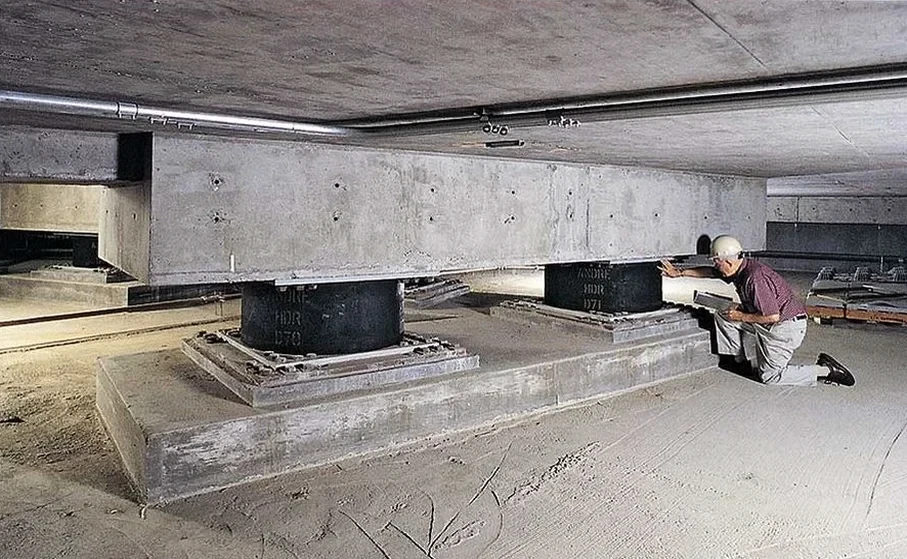
A base isolation system starts with the bearing. In our Salt Lake City projects, we typically specify lead-rubber bearings or high-damping rubber bearings placed between the foundation and the superstructure. The hardware arrives on site with mill certificates and elastomer properties already verified against the project’s displacement demand. At installation, the crew sets each isolator on a leveling pad, torques the anchor bolts to spec, and the whole assembly gets a protective wrap before the moat cover goes on. Downtown Salt Lake City sits on lacustrine sediments from ancient Lake Bonneville, and that soft soil profile amplifies long-period motion—exactly the kind of shaking that isolation handles best. For projects near the Wasatch Fault zone, we often coordinate the geotechnical campaign early, pulling undisturbed samples to feed site-specific response spectra into the isolation design. When the site investigation calls for deeper characterization, we back it up with a seismic refraction survey to map bedrock depth and identify velocity contrasts that affect ground motion at isolation periods.
A properly tuned isolation system can cut base shear by 60 to 80 percent compared to a fixed-base design—on the Wasatch Front, that translates directly to survival.
Service characteristics in Salt Lake City
Risks and considerations in Salt Lake City
In Salt Lake City, we often see project teams budget for the isolators but not for the moat details and utility crossings—and those line items add up fast. The moat has to accommodate full design displacement plus an allowance for torsion and accidental eccentricity, and every pipe, conduit, and stair across that gap becomes an engineered flex joint. Miss that in schematic design and you are looking at a six-figure change order before the structure is out of the ground. Another local pitfall is groundwater. Much of the valley floor has a shallow water table, and isolation pits below grade need permanent dewatering or fully tanked waterproofing. We have reviewed designs where the isolation plane sat a foot below seasonal high groundwater—correcting that meant raising the entire building. The Wasatch Fault can produce near-fault pulses with a significant velocity component, and those pulses can push an isolator into its hardening regime if the displacement capacity is tight. Peer review here is not optional; the University of Utah Seismograph Stations data feeds directly into the hazard models we use, and an independent check of the isolation parameters catches the edge cases that in-house teams sometimes overlook.
Our services
We provide full-service base isolation design out of Salt Lake City, covering everything from feasibility studies to construction-phase special inspection. Our work stays within the ASCE 7 framework and the Utah-adopted IBC, and every project gets a peer review from a second senior engineer before the drawings go out.
Isolation system design and peer review
Complete design package: site-specific hazard analysis, nonlinear time-history modeling, isolator specification, moat detailing, and utility crossing design. We also serve as independent peer reviewers for design-build teams and public agencies along the Wasatch Front.
Construction inspection and production testing oversight
IBC-required special inspection of isolator installation, prototype and production test witnessing per ASCE 7-22 §17.8, and final punch-list verification of moat covers and seismic gaps.
Common questions
What does base isolation design cost for a building in Salt Lake City?
For a mid-rise project in the Salt Lake valley, the design fee for a complete isolation package—including nonlinear time-history analysis, isolator specification, moat detailing, and peer review—generally falls between US$4,640 and US$9,550. The final number depends on the number of isolators, the complexity of the superstructure, and whether we are doing the full design or just peer review. Prototype testing and special inspection are billed separately because those costs depend on the isolator manufacturer's schedule and the construction timeline.
How does the Wasatch Fault influence isolation design parameters?
The Wasatch Fault is capable of producing near-fault ground motions with strong velocity pulses and permanent tectonic displacement. ASCE 7-22 requires near-fault adjustments to the response spectrum for sites within 5 km of an active fault trace. Salt Lake City has mapped fault segments running through the eastern bench, so most downtown projects fall within the near-fault zone. We incorporate pulse-type ground motion pairs in the nonlinear analysis and check the isolation system's displacement capacity against the amplified demand. The University of Utah Seismograph Stations maintains the catalog of recorded motions we use for ground motion selection and scaling.
Does base isolation work on soft Lake Bonneville soils?
Yes, and in some ways the soft lacustrine clays and silts under Salt Lake City actually make isolation more effective. Those soils naturally filter out high-frequency shaking while amplifying longer periods. Since an isolated structure has a fundamental period well above the soil's predominant period, the two systems work together to reduce the force transmitted into the superstructure. The key is getting the geotechnical site response right—we need shear wave velocity profiles down to at least 100 feet, which is why many projects start with a combination of downhole testing and surface-wave methods like MASW to constrain the site class per ASCE 7 Chapter 20.
What is the typical timeline for an isolation design package?
From kickoff to permit-ready drawings, a base isolation design for a Salt Lake City building runs about 10 to 14 weeks. Week 1-2 is geotechnical coordination and hazard analysis. Week 3-5 we run the initial nonlinear models and size the isolators. Week 6-8 is the design development phase where we detail the moat, the utility crossings, and the isolation interface. Week 9-11 is peer review and revisions. The final two weeks cover the special inspection plan and coordination with the structural engineer of record. Fast-track projects can compress that to 8 weeks, but only if the geotechnical data is already in hand.