Salt Lake City's downtown grid expanded rapidly after the 2002 Olympics, pushing construction into tight parcels between historic masonry and modern towers. Deep shoring became mandatory. Our anchor design work supports these projects. We define bonded lengths, free lengths, and lock-off loads for active tiebacks in sandy Lake Bonneville deposits. Passive anchors solve toe embedment problems in shallow rock. Every design references the actual stratigraphy we log on-site, not just regional assumptions. We often pair anchor design with slope stability to verify global failure surfaces behind the wall, and with deep excavations when the cut exceeds 20 feet near TRAX rail alignments.
A proper anchor test measures creep under sustained load. If the movement doesn't stabilize, the bond length is wrong.
Service characteristics in Salt Lake City
Risks and considerations in Salt Lake City
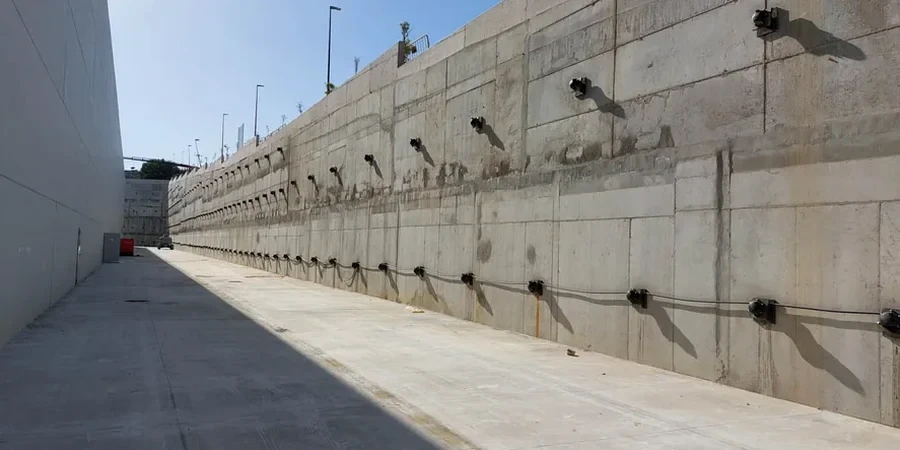
A common mistake is to treat every anchor as a passive bar just because rock is shallow. We saw a shoring wall on 400 South creep outward after a heavy rain. The contractor had assumed passive resistance in a weathered claystone lens. It wasn't rock. It was stiff clay that softened with moisture. The wall deflected enough to crack the adjacent sidewalk. We had to redesign the lower row with active anchors drilled deeper into competent material. A simple excavation monitoring program would have caught the movement before it became a problem. Lateral loads don't care about optimistic assumptions.
Our services
Our anchor design package includes field testing and shoring calculations. We handle both temporary excavation support and permanent retaining structures.
Active tieback design
Prestressed anchors with defined free and bond lengths. We calculate lock-off load and verify with lift-off tests after stressing.
Passive anchor design
Fully grouted bars for rock or stiff soil. We design the embedment depth to mobilize passive resistance against the failure plane.
Proof and performance testing
We run creep tests, cyclic load tests, and extended-duration hold tests per PTI standards. Every anchor gets a calibrated load cell reading.
Shoring shop drawing review
We review contractor submittals for soldier pile and lagging systems. Anchor spacing, inclination, and corrosion protection are checked against our design basis.
Common questions
What is the difference between an active and a passive anchor?
An active anchor is tensioned after installation. It applies a predefined force to the wall before any soil movement occurs. A passive anchor is not tensioned. It only develops resistance once the wall starts to deflect and compresses the soil around the bonded zone.
How much does an anchor design package cost?
A full design package for a typical shoring project in Salt Lake City ranges from US$1,150 to US$4,080. The price depends on the number of anchors, the required testing protocol, and the complexity of the soil profile.
How long does an anchor take to install and test?
Drilling and grouting one anchor takes about half a day. The grout needs to reach minimum strength before stressing. That is usually 3 to 5 days with Type I cement in summer. Performance testing adds another 2 hours per anchor on the stressing day.
Do you handle the corrosion protection design?
Yes. For permanent anchors we specify double corrosion protection with corrugated sheathing and grout encasement. Temporary anchors use single protection. We follow PTI Class I and Class II recommendations based on the design life of the structure.