A medical office building going up near the University of Utah campus hit a snag: the upper gravels looked fine, but the clayey silt underneath was telling a different story during excavation. The structural engineer needed more than a standard N-value from an SPT—they needed to know how that fine-grained layer would behave under the final column loads with pore pressure buildup factored in. We ran a consolidated-undrained triaxial test with pore pressure measurement on undisturbed Shelby tube samples taken from 18 feet down. The results gave them effective friction angles and cohesion intercepts that the presumptive bearing tables in the IBC simply couldn't provide. When Salt Lake City projects push into the transitional soils left by Lake Bonneville, a properly executed triaxial program becomes the difference between a conservative guess and a defensible foundation design. Close coordination with the drilling crew during sampling ensures the specimens arrive at our lab with minimal disturbance—a detail that matters more here than in many other regions because the lacustrine clays are sensitive to remolding. For deeper liquefaction-prone layers near the Jordan River corridor, the data pairs naturally with a CPT profile to bracket soil behavior across different strain ranges.
Lake Bonneville clays don't behave like textbook materials—triaxial testing on undisturbed samples is the only way to nail the effective stress parameters.
Service characteristics in Salt Lake City
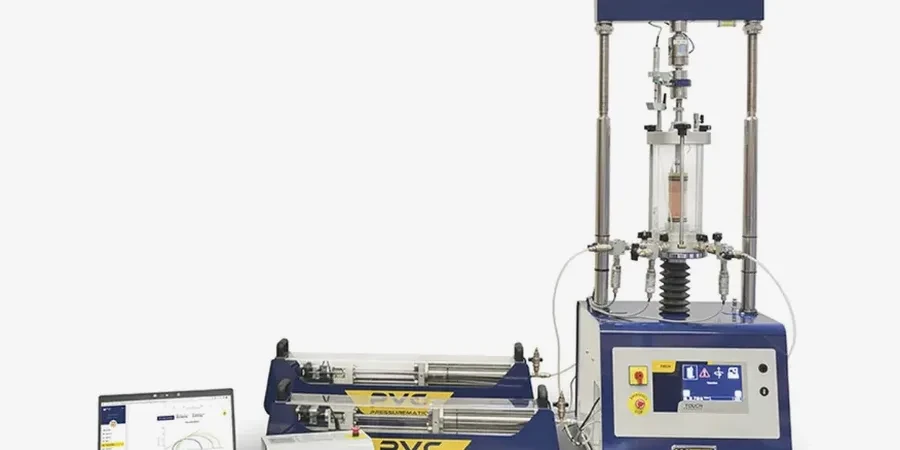
Demonstration video
Risks and considerations in Salt Lake City
The Foothill Drive corridor and the lowlands west of I-15 might as well be two different cities from a geotechnical standpoint. Up on the benches, you're dealing with dense alluvial fan deposits and occasional cemented gravels that give you high blow counts and a false sense of security—until a thin clay interbed goes unnoticed. Down in the valley near the airport, the same Lake Bonneville clays can be thirty feet thick, normally consolidated, and prone to long-term settlement under fill. A single set of triaxial data from the bench zone might show a friction angle above 35 degrees and negligible cohesion, while specimens from the valley floor often come back with effective friction angles in the 24–28 degree range and a significant drained cohesion intercept that changes the entire settlement-risk picture. Overlooking the stratigraphic nuance and running only index tests means the final foundation recommendation might be too optimistic on one side of town and unnecessarily expensive on the other.
Our services
The triaxial test is rarely ordered in isolation. In a basin like Salt Lake City, you typically need supporting data to build a complete geotechnical model.
Triaxial Test Suite with Sampling Protocol
We coordinate with local drillers to specify Shelby tube diameter, handling, and transport that preserves sample integrity for CU and CD testing on Salt Lake Valley lacustrine deposits.
Effective Stress Analysis Package
Combines triaxial strength envelopes with consolidation data to produce bearing capacity and settlement curves for footings and mat foundations, formatted for direct input by the structural engineer.
Common questions
How much does a triaxial test cost in Salt Lake City?
A standard set of three specimens (CU with pore pressure measurement) typically runs between US$2,050 and US$2,890, depending on whether undisturbed Shelby tube samples are provided or we need to prepare remolded specimens at a target density. Consolidated-drained tests take longer and sit at the upper end of that range due to the slow shearing rate required.
Which triaxial type do I need for a foundation in the Salt Lake Valley?
It depends on the drainage conditions during loading. For fine-grained soils where construction is fast relative to consolidation—common for building pads placed over Lake Bonneville clays—a CU test with pore pressure measurement gives you both undrained strength for short-term stability and effective stress parameters for long-term settlement. For free-draining sands and gravels on the east bench, a CD test is more appropriate.
How are the samples collected for triaxial testing?
Undisturbed samples are obtained using thin-walled Shelby tubes pushed with a hydraulic system, not driven with a hammer. The tubes are sealed immediately with wax and plastic caps, transported upright, and stored in a humidity-controlled room at our lab. For projects near the Jordan River where groundwater is high, we often specify a piston sampler to reduce disturbance in soft clays.
How long does it take to get triaxial test results?
A CU triaxial set of three specimens takes seven to ten business days from sample extrusion through final report. CD tests take two to three weeks because the shearing stage must be slow enough to prevent excess pore pressure. We can expedite if the contractor is waiting on numbers for a footing redesign.
Do you run triaxial tests on remolded samples?
Yes—when undisturbed samples aren't feasible, we compact remolded specimens to the field density and moisture content specified by the geotechnical engineer. This is common for fill quality control on large commercial pads in the Northwest Quadrant, where the borrow source needs shear strength verification at a target relative compaction.