Salt Lake City sits at 4,226 feet, wedged between the Wasatch Front and a prehistoric lakebed that still dictates subsurface behavior today. The 2020 Magna earthquake—a M5.7 on the West Valley fault zone—was a wake-up call for anyone designing foundations on the valley's layered sediments. CPT soundings give us a continuous, real-time profile that standard SPT borings simply can't match in these interbedded silts and clays. When a project near the Jordan River corridor encounters soft Bonneville clays overlying liquefiable sands, we push a 15 cm² cone to capture tip resistance, sleeve friction, and pore pressure in a single stroke. The data feeds directly into bearing capacity calculations and seismic settlement estimates without the disturbance that split-spoon sampling introduces. For engineers working in the downtown liquefaction zone or on the deep lakebed deposits west of I-15, the CPT becomes the primary tool for quantifying undrained shear strength and soil behavior type with a resolution that drilling logs alone never achieve.
A CPT sounding in Salt Lake City's basin fill gives you a four-parameter log—tip, sleeve, pore pressure, and shear wave velocity—every 2 centimeters from the surface to refusal.
Service characteristics in Salt Lake City
Risks and considerations in Salt Lake City
The Avenues district, perched on the Lake Bonneville highstand terrace, shares almost nothing geotechnically with the warehouses out near 2100 South and 5600 West. Up on the terrace, gravel refusal at 12 feet is routine. Out west, you're pushing through 40 feet of soft clay before reaching competent material. The risk materializes when a structural engineer applies the same bearing pressure assumptions across both sites. We've reviewed CPT logs near the airport where corrected tip resistance (qt) stays below 20 tsf for the first 30 feet—and that's before factoring in the cyclic softening potential under the MCE-level ground motions required by IBC. A shallow footing designed without a CPT-based settlement analysis in those conditions can rack up differential settlement exceeding 1.5 inches within the first five years. In the downtown core between North Temple and 400 South, the presence of uncontrolled fill from the pioneer era adds another layer of uncertainty. The cone catches those fill pockets instantly through erratic friction ratios that don't match the native stratigraphy, something a standard boring log with intermittent sampling can smear right through.
Our services
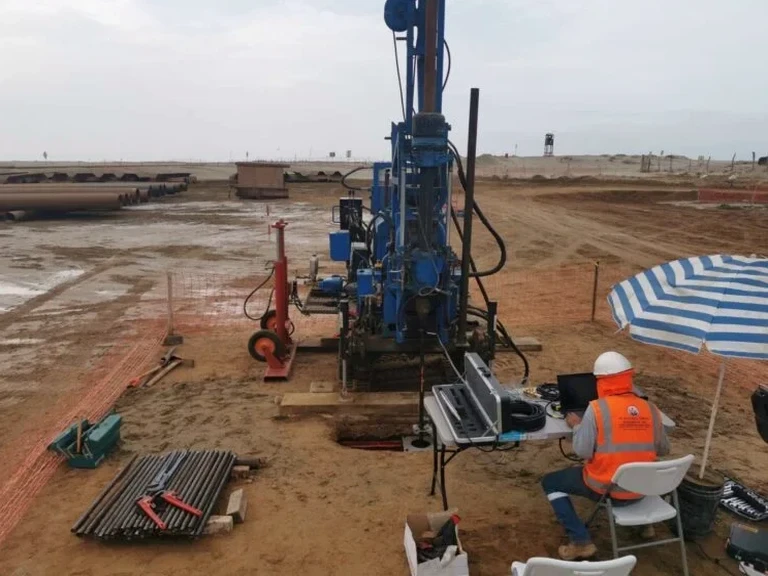
Our CPT program in the Salt Lake Valley covers the full workflow from mobilization to engineering interpretation, specialized for the basin's lacustrine deposits and high seismic demand:
Seismic Cone Penetration (SCPT)
Pore pressure cone sounding with a downhole geophone array for direct shear wave velocity measurement. We deliver Vs profiles for Site Class A through F determination, ground motion amplification studies, and liquefaction assessment in the Salt Lake Valley's shallow groundwater zones.
Piezocone Dissipation Testing
Stopped-push pore pressure dissipation at selected depths within the Bonneville clay sequence. We calculate the coefficient of consolidation (cv) and hydraulic conductivity (k) directly from t50 decay curves, eliminating the need for time-consuming laboratory consolidation tests on undisturbed samples.
CPT-Based Foundation Analysis
Direct design parameter extraction for shallow and deep foundations using LCPC, Schmertmann, and Eslami & Fellenius methods. We provide bearing capacity factors, settlement estimates, and pile unit side friction and end bearing values from the cone data, calibrated for the valley's interbedded profile.
Common questions
How much does a CPT sounding cost in Salt Lake City?
A single CPT sounding in the Salt Lake Valley typically runs between US$150 and US$270 per meter of penetration, depending on the depth, the inclusion of the seismic module, and the number of pore pressure dissipation tests required. Mobilization within the Wasatch Front is billed separately and depends on the rig size and access constraints at the site.
What depth can a CPT rig reach in the Salt Lake Valley?
Our 20-ton rig can reach 80 to 100 feet in the soft clays of the central and western valley before hitting refusal on the Salt Lake Formation or dense gravels. In the eastern bench areas near the Wasatch Fault, refusal on coarse alluvial gravel often occurs between 15 and 30 feet.
Can CPT replace SPT borings for foundation design?
In the fine-grained basin fill that dominates much of Salt Lake City, CPT data often replaces SPT for bearing capacity and settlement calculations, providing a near-continuous profile rather than readings at 5-foot intervals. However, for projects requiring physical samples for lab testing—such as Atterberg limits or consolidation curves—we still recommend pairing the CPT with at least one companion boring.
How does CPT help with liquefaction analysis in Salt Lake City?
The CPT provides normalized tip resistance and friction ratio data that feed directly into the Boulanger & Idriss (2014) liquefaction triggering correlation. Combined with the shear wave velocity from the seismic module and the measured groundwater level, the sounding generates a factor of safety against liquefaction at every centimeter of depth—critical in the northwest valley where the water table is high and the sands are loose.
How long does a CPT sounding take, and what access do you need?
A standard 60-foot CPT sounding with three dissipation tests takes about 2 to 3 hours to complete. We need a cleared, level working area of roughly 15 by 25 feet for the truck-mounted rig, and overhead clearance of at least 18 feet. In tight urban lots in downtown Salt Lake City, we can mobilize a smaller track-mounted unit that fits through a 6-foot gate. More info.