When you hit those gray, sticky clays just six feet down on a site near the Jordan River, you know you're dealing with the old Lake Bonneville sediments that define Salt Lake City's subsurface. We've seen it countless times in Sugar House and the Glendale area—excavation spoils that look dry on the surface but turn into a plastic mess with a little moisture. The lab runs Atterberg limits testing under ASTM D4318 to pin down exactly where that soil transitions from semisolid to plastic to liquid. For Salt Lake City's highly expansive lacustrine deposits, knowing the liquid limit and plasticity index isn't academic; it predicts how much that foundation soil will swell when the winter snowmelt raises the groundwater. A test pit log combined with our Atterberg data gives you the full picture before structural design starts, and if the clay fraction is high, you'll want to check slope stability for any cuts on the east bench foothills.
Salt Lake City's Lake Bonneville clays can swing from a plastic limit of 18 to a liquid limit over 70 within the same project boundary—missing that range during classification is what triggers change orders later.
Service characteristics in Salt Lake City
Risks and considerations in Salt Lake City
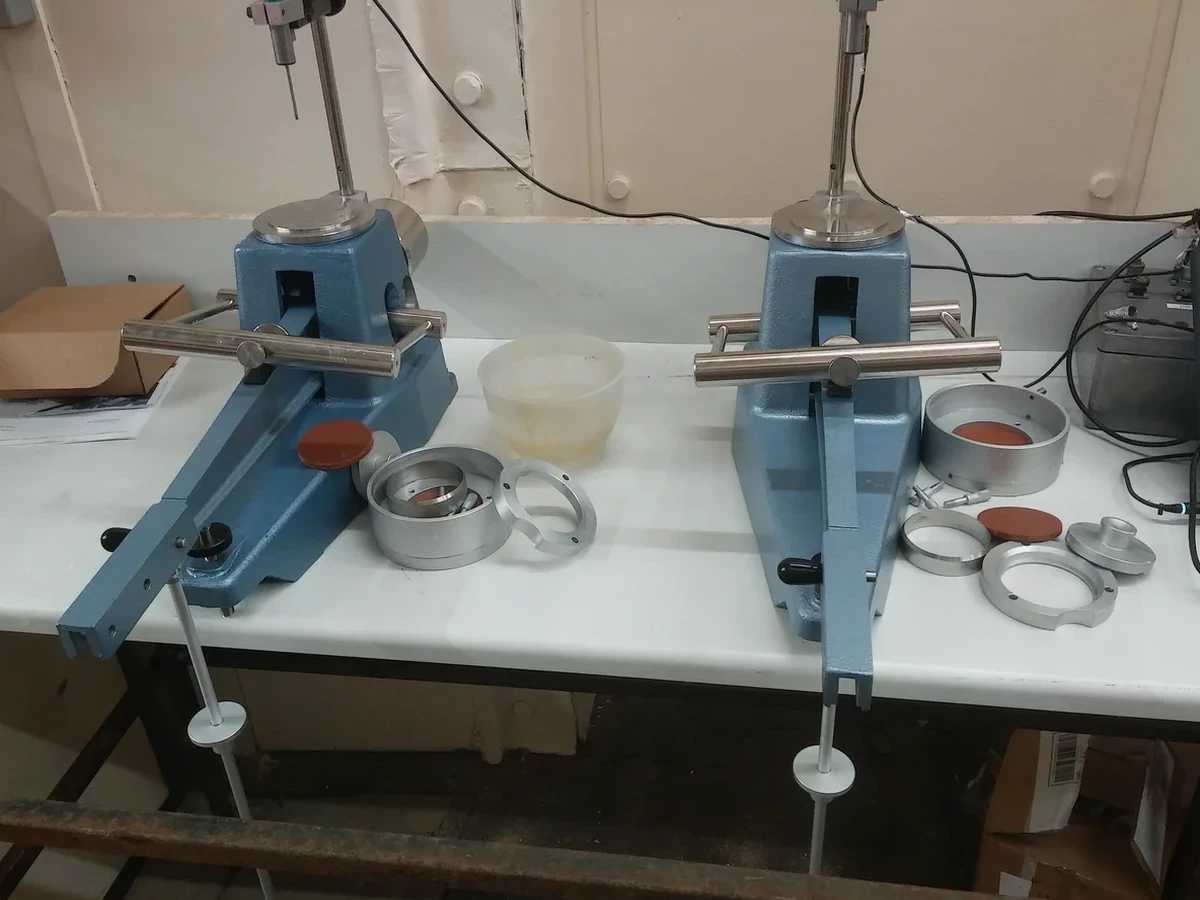
We run the Casagrande cup on a granite countertop in a temperature-controlled lab—the same brass cup and grooving tool specified since Arthur Casagrande standardized the method. In Salt Lake City, the real risk isn't the equipment but the sample: letting that Bonneville clay air-dry on site before it reaches us artificially lowers the liquid limit by 5 to 10 points because the clay minerals partially dehydrate and won't fully rehydrate. That misclassification can lead a geotech to label a CH soil as CL, underestimating swell potential and setting up foundation movement down the road. The ASTM D4318 procedure requires oven-drying at 110°C, but we also run a split comparison on select samples with air-dried preparation when the contractor suspects organic content or gypsum—common in the southeastern valley near the Kennecott tailings influence. Ignoring the liquidity index derived from these limits leaves the contractor blind to whether the soil will behave as a brittle solid or a viscous fluid during trenching.
Our services
Our Salt Lake City lab runs the Atterberg limits suite as a standalone classification service or integrated into larger geotechnical campaigns. The results are reported within 48 hours for standard projects.
Full Atterberg Limits Determination
Complete liquid limit, plastic limit, and plasticity index testing on disturbed samples per ASTM D4318. Includes flow curve plot, natural water content comparison, and USCS classification per ASTM D2487. Suitable for foundation investigations, borrow source evaluation, and forensic studies on distressed slabs.
Soil Classification Package with Atterberg
Combine Atterberg limits with sieve and hydrometer grain size analysis for full USCS classification. We provide the plasticity chart with the A-line and U-line plotted so the design team can immediately see if the material classifies as CL, CH, ML, or MH. This package is standard for IBC Chapter 18 compliance submittals.
Common questions
What's the typical cost for Atterberg limits testing in Salt Lake City?
For a standard liquid limit and plastic limit determination on a single sample, the fee falls in the US$70 to US$90 range. Projects with multiple samples or those requiring rush turnaround within 24 hours carry adjusted pricing. The cost includes the full flow curve plot, natural water content, and USCS classification per ASTM D4318 and D2487.
How long does it take to get Atterberg limits results back?
Standard turnaround is 48 hours from sample receipt. The process includes overnight oven-drying at 110°C, soaking and mixing the passing No. 40 fraction to a uniform paste, then running the Casagrande cup for the liquid limit and hand-rolling threads for the plastic limit. We can expedite to 24 hours for an additional fee when the drill rig is waiting on classification to decide termination depth.
What sample quantity do you need for Atterberg testing?
We need roughly 500 grams of disturbed material passing the No. 40 sieve. A quart-sized bag of representative soil from the zone of interest works well. If the sample arrives wet from a Salt Lake City site, we prefer it sealed in an airtight container so we can measure the field moisture content before drying—that comparison to the plastic limit tells you immediately if the soil is in a plastic state in situ.
Why do Atterberg limits matter for foundations in Salt Lake City?
The Lake Bonneville clays beneath much of the valley floor have high plasticity indices, often exceeding 25. A PI above 25 combined with a high clay fraction signals significant swell-shrink potential. When a foundation is designed without knowing the liquid limit and plasticity index, the engineer can't properly estimate the expansion index or the required overburden to suppress heave. These limits also control the selection of suitable backfill and the design of moisture barriers around slabs.